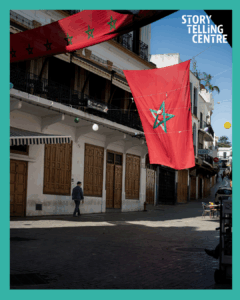
Have doubts? What on earth is Afellay supposed to have doubts about? His roots? Just to prove that he’s actually a true Dutchman? That he was worthy of playing for the Dutch national team?
Quite apart from the fact that I believe everyone should simply cheer for whichever country they want to cheer for – and that I find the notion of ‘nationalism’ demanding that you support the country where you live or were born to be so last century – this whole incident lays bare something that has a lot to do with narratives. Something we encounter very regularly in our work: the dominant narrative. I’d almost go so far as to say: the stubbornly dominant narrative.
This narrative exists everywhere, and you can view it at a national level or, conversely, very locally, within communities. But you can also zoom out and see how certain narratives are embraced across the whole world. Sometimes in a very subtle way. The old colonial narrative, for example, is often still dominant, although fortunately more and more cracks are appearing in it. The narrative of those in power – whether in the police or the economy – is the narrative you have to follow if you want to fit in, and the narrative that defines what success is. You could say, for instance, that we are currently dealing with a dominant capitalist narrative, in which everything is measured by economic value and a full wallet is seen as the ultimate goal. Elon Musk has made it big, whilst we hardly ever ask ourselves whether that man is actually happy. Pursuing those kinds of ‘soft’ values ranks lower in the current narrative.
Which is not to say that everyone slavishly follows that narrative. Of course, there are also people who prioritise the pursuit of a balanced life above all else. And Afellay wasn’t the only one in the Netherlands cheering for Morocco. I might well have done too*. But if you embrace a different narrative, you have to fight for it. You have to constantly explain yourself. After all, why did Afellay have to explain why he supported Morocco? Can’t we just accept that? Just as you often have to explain that you won’t do anything for big money. Or why you don’t eat meat.
If you’re constantly confronted with it, you start to see ever more clearly how dominant discourses continue to influence us.
It is precisely minorities (in many areas) who are constantly confronted with this. Whilst there is also a group for whom that dominant narrative fits like a glove. As is perhaps the case for the majority of sports journalists. And how unfortunate it is, then, that they cannot simply adopt the other person’s perspective, as the example I began with illustrates.
There is still a long way to go, I might sigh. But I do not believe we will ever reach a point where all stories can coexist on an equal footing and be respected. That does not, however, absolve us of the duty to speak out on this matter and to dare to question things when other stories are dismissed in a completely disrespectful manner.
*In all honesty, I must say that I did not cheer for either Morocco or the Netherlands. I was fast asleep in Italy.