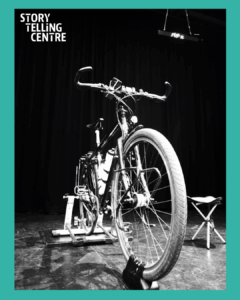
But after the coffee, it was no longer there. Whilst I was sitting less than a hundred metres from the car park drinking a flat white with oat milk, someone apparently felt the need to rip my bike loose and take it with them, leaving behind a damaged bike rack.
You’re left standing there looking rather dejected for a moment. Not just because of the sheer force used, but also because that bike, which had become so familiar and on which I’d performed thirteen shows by now, was suddenly gone.
I’ll spare you the details of the police report and insurance claim, but I do want to share a thought with you – one I had myself and, funnily enough, was also messaged to me by a very good friend later that day, whilst I was on the ferry. He wrote: ‘After the bike had fulfilled its role in Patrick’s life and in the performance, someone stole it (most likely) to sell it, so that it can have a fresh start and a new purpose.’ It came dangerously close to my own thought: ‘perhaps this is a sign that this really was the last time I performed this show.’
I’m not just writing this down as an anecdote. What matters to me far more is how you can use your own story to come to terms with something. Because the story of my good friend and my own are, of course, entirely personal stories, with no basis in facts or reality. But that doesn’t matter either, because this story did help me to make peace with what had happened. In fact, I gave it a beautiful meaning, as if the circle was now complete and I could move on to the next phase.
Someone else might have constructed a completely different story and focused much more on the suffering endured, or the fact that Glasgow is apparently a very unsafe city. These are also valid stories, which might have helped them to come to terms with the event. What is important here is that we have a choice. As human beings, we can often choose which story we attach to an event or a memory.
We can determine what value and – above all – what meaning we choose to attach to it.
A large part of my work in the field of personal growth revolves around this. We encourage people to explore different perspectives within a story and to choose which story they ultimately wish to embrace. In principle, there is no right or wrong here. All stories are allowed to exist. But we do try to encourage positive stories to prevail. And believe me, these aren’t always based on positive events. But if you’re able – even if it takes time – to see the positive in the negative too, then that certainly contributes to everyone’s mental resilience.
Of course, I haven’t come up with all this myself. I rely heavily here on the technique of re-authoring, which I discovered through reading the books of Michael White, one of the founders of narrative therapy. He worked with people who were struggling and whom he managed to encourage to rewrite certain entrenched stories and give them new meaning. I firmly believe in this and hope that by running workshops and training sessions, we can encourage more people to dare to choose a different perspective. Whether your bike gets nicked or not.